
A Man Needs a Home
Black Book 64: November 11, 2008

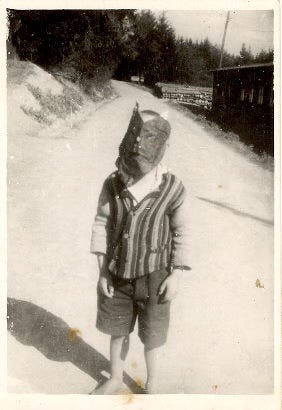
I’ve always believed that a man needs a home. Not just a roof over his head, but a place that feels like home, a comfortable place full of memories and at least the remnants of dreams. A real home is the kind of place a man looks forward to returning to at the end of a long day or a long journey, a place where he can get up in the middle of the darkest night and not just know exactly where he is, but can make his way from room to room without turning on a single light.
Some people, of course, never find the sort of home I’m talking about, not even in childhood. Others, the truly fortunate, might have a number of such homes in their lifetime; some, I suppose, have a gift for making a home for themselves anywhere they go in the world. But a true home—whether it’s the place you grew up or the house or apartment where you currently live—is a space which, wherever you are or however long you’ve been gone, you can, in your mind’s eye, envision room by room, wall by wall, and detail by detail.
I once knew a mentally ill man, who was in his late-thirties, who used to spend hours every day making elaborate and obsessively detailed sketches. At the time, this man was living in an institution, and it was difficult to get even a half-dozen monosyllabic words out of him in a day. Over the two years I knew this man he produced thousands of these sketches, many of them almost exact replicas of his previously completed drawings. He would draw shelves crowded with books, and in these sketches the books were always in the same order and leaning at the same angle. There were multiple versions of a lamp with a pirate ship base, its shade imprinted with skull and crossbones. It was virtually impossible to find any variations from drawing to drawing; the perspective, shading, and details were unvarying. There were also countless sketches of intricate, textured patterns, endless images of the same patterns or motifs. One such series featured various patches of colors arranged in a checkerboard pattern, slightly irregular (but, again, the irregularities from drawing to drawing were identical). Another obsessive pattern was celestial in nature—planets, stars, lines drawn between the individual stars in constellations, a rocket ship plunging through space. The same motif, everything in the same place, repeated over and over on each page and spilling over into other pages. Another series of drawings was of a red cowboy hat dangling from a tack on a wall, next to which was a print of three monkeys playing guitars.
There were assorted sketches of figurines—cowboys, Indians, and horses were a recurring theme—and of an intricately detailed model of the moon, the skeleton of a frog, and what appeared to be a stuffed toy designed to look like a friar. There were hundreds of drawings of shoes, splattered with paint and neatly lined up under a bed; of a solitary stick propped in a corner; and of an empty picture frame on a dresser or bed stand.
The man had been diagnosed with schizophrenia, and he had a violent history and was heavily medicated. His drawing was a regular subject of staff debate. There were those who thought it best to discourage what was clearly obsessive-compulsive, anti-social behavior.
Shortly before I left my position at this institution, I was allowed to take the man on a visit to his mother, who was elderly and had a terminal illness. An older brother, I was told, would also be present for this meeting. The mother’s house was located in a small town a relatively short distance from the city where the institution was located. When we arrived, the man—the patient—was remarkably subdued and compliant. There had been no problems, disturbances, or conversation on the drive.
The mother was installed in some sort of hospital bed in the front room. The brother met us at the door. He was an open-faced, friendly-seeming man who appeared to be in his forties. I remember he initially shook his brother’s hand before attempting an awkward embrace, to which the patient offered nothing in the way of a reciprocal response.
The mother, I also remember, reached for the patient’s hand, held it for a brief moment, and then gave it a feeble kiss, after which her son wandered from the room and disappeared down a dark hallway. He reemerged a short time later, cradling a globe of the moon in his arms.
“Put that back where it belongs,” the mother said, and then turned to me. “Make him put that back before he starts dragging everything out here.”
I led the man down the hallway—or rather he led me—and I found myself surrounded by his drawings. Every detail was there, exactly as he’d sketched them hundreds and thousands of times: the checkerboard quilt on the bed, the closed curtains with the space motif; the pirate ship lamp, the red cowboy hat, the guitar-playing monkeys; the frog skeleton, stuffed friar, stick in the corner; the painted shoes, the books on the shelves, and on the bed stand a framed photo that was clearly my disturbed patient as he had looked when he was a smiling, apparently happy boy.
I can see those drawings in my mind.
Perfect