


The warm glow was coming in waves now. He could feel himself being carried.
He considered himself a merry man, and like many a merry man he was given to protracted squalls of seemingly impenetrable darkness, but these episodes merely cast his merrymaking in an even brighter light. He knew, though, that the clouds could sweep in at any time, the heavy black curtains could be drawn, and when he was moving in the light he was smart enough to allow himself to be swept along.
Was it merely nostalgia if you still enjoyed many of the same things that had given you such uncomplicated joy as a child, and received the same wondrous and visceral pleasure that you had in your earliest years?
He didn’t care, honestly, and wasn’t a fellow who had any problems with nostalgia. Certainly, yes, there were people who were crippled by it and lived exclusively in the past, but for him the past, and the fond memories he reliably found there, seasoned the present and intensified the way in which he experienced it.
It was all the river, and he loved the river, loved the feeling of being moved, loved even the feeling of being swept away. It was a terrible thing to feel time and time again as if your spirit had been broken, but in the midst of such ordeals it was also a marvelous experience to suddenly find oneself transported, often inexplicably, back to the merciful light of the world.
There was much in the world to be cherished, and his life had ultimately made him soft and sentimental; his suffering had tenderized him. All of this was preferable, he thought, to the alternatives; he had plenty of acquaintances who had grown hard and cynical, and he understood perhaps too well how a person could end up in that place.
Somehow, however, he had been spared, and he was grateful. Perhaps his continuing existence was owing to the fact that he had very early in his life been given such a fierce love for music, books, art, conversation, and laughter. These things, in fact, couldn’t even properly be called diversions, so inextricable were they from what by any definition constituted his life and his character. All of them took his head, heart, and spirit into places they wouldn’t have otherwise gone.
Again: He felt carried. Again: He’d truly been swept along, and was still hoping to be swept away. Again: It was all the river, and the river had been the dream and the metaphor for his life since the days in his childhood when he had first discovered Wind in the Willows and Huckleberry Finn.
So often the big question of his life had been this: Given all the information presently at your disposal, would you be willing to spin the chamber and take your chances? The answer usually depended on what was at stake; if you were talking straight Russian Roulette—no metaphor—his question would be why? For kicks? For the sheer, risky thrill of it?
Not likely, he would say. Not now. But if you were speaking metaphorically, then he would ask what sort of metaphor you were talking about. Because in life there were Russian Roulette sorts of moments and choices, and then there were the roll-the-dice sorts of choices. The latter, of course, was a less risky game, less intense, more playful, at least generally.
But there were obviously all sorts of levels of risk, just as there were different levels of rewards, and the greater or more lucrative the reward, the more people seemed to be willing to take extravagant chances and invest ever more extravagant hopes.
Perhaps such risks were actually—at least metaphorically—the equivalent of playing Russian Roulette with the gun pointed at your heart instead of your head.
So, he would say, the question remained: Why? Why bother? Why subject your heart or head to the possibility of being shattered? And he could come up with only one answer: Because the only way to live was to subject yourself —and your head and your heart—to just such risks. The option? Nothingness. The relentless, disabling, day-after-day sort of nothingness that now seemed to represent the parameters of so many 21st-century lives.
And then: Okay, he’d finally say. I’ll take the gun. I’ll spin the chamber and take my chances. Because he’d had his fill of nothingness and the anger and frustration and impotence it bred. He decided that he was willing to feel, to let his heart be pummeled, shattered, inflated, drowned, impaled on a hook and cast out into the world as bait. He decided it was time to let the beautiful fish nibble, to take their bites, even at his peril. Because he had nothing left to lose.
Was this confusing? Was he confused? Yes, in all likelihood it was and he was, but he had spent enough time in the soup, the murk, the muddle of winter, and he was no longer sure about anything, not sure about anything at all. The world had him right where it wanted him, and he was trying to teach himself that that was just fine and dandy.
Once upon a time there was a boy who dreamed a world, and through much of his early life he looked in vain for the world he had dreamed.
Now and then he had had glimpses of it, but these were nothing but dissolving fragments of the world he had once imagined, and there were never quite enough of them for him to even begin to reconstruct the whole.
At some point the boy became a man, and began to realize that it was probably a mistake to dream a world when you were trying to navigate a planet that offered challenges enough for a lifetime.
That didn’t matter, however; it was too late. He had dreamed a world, and though it was dramatically different from the world in which he found himself, there was no shaking it.
The project of his life, he eventually recognized, was to somehow succeed in swapping out the so-called real world for the world of his early dreams. He was running out of time, but he nonetheless regarded this as a worthy project for the time left to him.
When on rare occasions he tried to explain this project to other people, he would be compelled to emphasize that there wasn’t anything utopian or pie-in-the-sky about his dream; it wasn’t, strictly speaking, even a critique of the world as it was. It was just a different world, a world wholly of his own creation, his imagination, and a world he could take refuge in when he was tired of living in the real world.
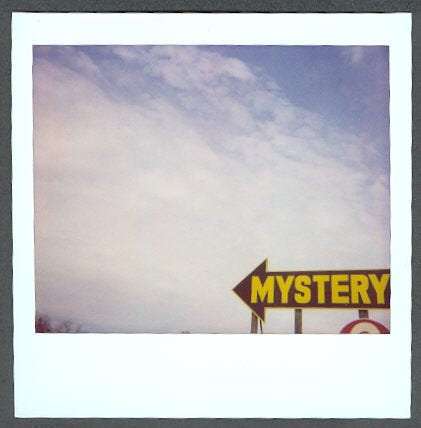
It was, he supposed, a magical place, but as was the case with much magic, it was also a place of much darkness and mystery, as well as much bewildering and beautiful light. And all of those things were the ingredients he required in order to dream.
Only as he neared the end of his life did he begin to understand that all along he had in fact been living in the world he had dreamed, and that he had wasted much of his time and energy in trying to find a way to escape from it.
Thank you for these. I forwarded the email to a friend who could be the subject of the first story. I'm debating sending it to a friend who, I hope, will embrace the second.